What Humpback Whales Are Singing About — And What Scientists Are Finally Learning 🐋!
I love whales. I love the ocean. And I've always been fascinated by the people who dedicate their lives to understanding what happens beneath the surface of that enormous, mysterious world. I'm guessing I'm not alone.
When I was about sixteen or seventeen, my family would take a summer trip to Captain John's in Plymouth, Massachusetts, a legendary whale-watching destination. Those trips were always an adventure.You'd stand on the port or starboard side near the bow, binoculars in hand, scanning the horizon for a spout of water or the briefest glimpse of a watch documentaries, but being there is a different experience altogether. One particular trip has stayed with me all these years. We had a young marine biologist explaining what we might see that season, which whales had been moving through the area, and what the team had observed during the preceding week.
Then, suddenly, she let out a scream of excitement. "Everybody! You may never experience this again in your life! There's a blue whale passing right below us!" She was practically beside herself. And so were we.
And just to give you an idea of the scale we're talking about. An entirely different encounter, but a remarkable illustration of scale: a blue whale swimming alongside a 75-foot boat. Imagine seeing something like that pass beneath you!
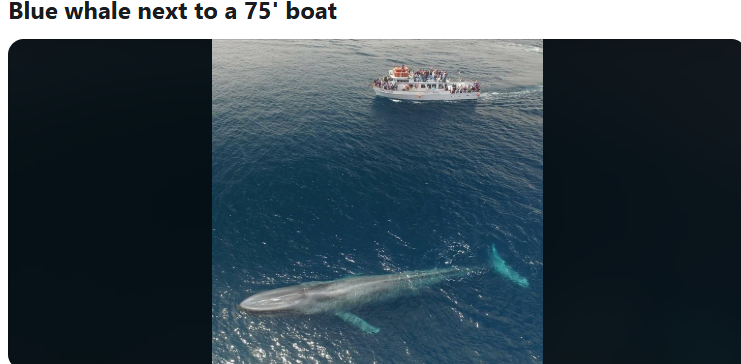
The Whale That Changed Everything.
Blue whales are enormous. Adults typically reach around 80 to 100 feet in length, with some exceptional individuals growing even longer. They are the largest animals known to have lived on Earth.
Our guide estimated where the whale was beneath us and directed everyone to the sides of the boat so we could get a better look.I remember trying to imagine just how big this animal was compared with the vessel carrying us. My memory may have grown a little fuzzy over the decades, but I remember being stunned by its sheer scale. Picture a teenage boy who already loves the ocean suddenly realizing that an animal of that size is swimming right beneath his feet.
Yeah. That'll make an impression.
I wanted to see a blue whale again. More than that, I wanted to understand whales and the world they inhabited. My grandmother was a marine biologist at Woods Hole, and she had already taught me a great deal. That connection made the subject even more meaningful to me. I still have a dream on my bucket list: to scuba dive in Canada, where the rules and conditions permit it, and experience a whale in its natural environment as closely as is safely and legally possible.
I'd love to look one in the eye. I've scuba-dived four times, although it's been years since my last dive. My friend Jeremy, a professional diver, has reminded me that approaching a whale underwater is not something an inexperienced diver should attempt. An animal that large can change direction or move water powerfully without even realizing a person is nearby. He's right. Respecting wildlife means respecting the fact that we're visitors in their world. Still, when prepared in 3 years? I'm DOIN IT!
I imagine that being close to a whale in its natural environment would be one of the most extraordinary experiences of my life. For me, it would feel like getting a little closer to something much bigger than myself. So when I came across a recent article about new research into humpback whale songs, I was immediately interested. And then I discovered that scientists had learned something about those songs that I hadn't expected.
Apparently, Whales Have More Going On Than I Thought.
The research, reported by ECO Magazine, examines a fascinating connection between the structure of humpback whale songs and the animals' movements underwater. You know I like a good story, and here's where I have to admit something.
Something humpback whales and I have in common is an unabashed pleasure in singing spontaneously in public. Put on a great song when I'm happy, and I may sing along without giving much thought to the people around me. I guess you can im agine as good a singer as I am, I get stares. And sometimes the audience appears to be wondering whether there's an emergency that requires them to leave the building. I like to think of it as "fishing" for attention and compliments. Staying with the aquatic theme, of course.
For male humpback whales, however, singing is serious business. Their complex songs can last for hours and travel considerable distances underwater. These songs play an important role during the winter breeding season, when males sing as part of their reproductive behavior. Scientists have studied humpback songs for decades. Researchers have learned a great deal about their structure, recurring patterns, and how songs change over time. But there was still an important question. What exactly are these whales doing physically while they're singing?
My first reaction was that the answer seemed obvious. They're swimming, navigating, communicating, and staying connected with other whales. Perhaps their songs serve as a kind of underwater communication network, developed over generations in an environment where sound can travel much farther than our eyes can see. I had a theory. It sounded reasonable enough to me.
Then I read further. As it turns out, scientists were investigating something much more specific: whether the structure of a whale's song changes in predictable ways as the animal moves through different parts of a dive. I had jumped to the conclusion before getting to the evidence.It happens. Even to people who think they're pretty good at asking questions.
How Do You Study a Singing Whale?
Imagine trying to study an animal that can move through an enormous underwater environment, disppear from sight, and sing for hours at a time. You can't exactly ask it to come into the laboratory, sit in a chair, and answer a few questions. And I suspect the scheduling department would have a difficult time arranging the appointment. To investigate the connection between singing and movement, Julia Zeh and her collaborators worked with researchers in Susan Parks' Bioacoustics and Behavioral Ecology Lab at Syracuse University. The team studied humpback whales off the coast of Maui, collecting data over a research period spanning 2018 to 2024. Their solution was both clever and remarkably practical.
Researchers temporarily attached small recording tags to the whales using suction cups. About the size of a tablet, these devices recorded the whales' underwater sounds and movements.The tags were attached from small boats using long poles and, more recently, drones. Yes, drones! Marine biology continues to find ways to combine old-fashioned fieldwork with technology that would have seemed extraordinary a generation ago. The tags eventually lost suction and detached, allowing researchers to retrieve the devices and download the recordings. The team tagged 16 whales, giving them a substantial collection of recordings to analyze.
I have to admit that reading about the tags detaching was a relief. Imagine going about your daily business and discovering that somebody had attached one of those department-store security tags to your shirt and forgotten to remove it. You'd be walking around wondering, "What the heck is this thing, and who put it there?" I'm sure the whales had no interest in participating in a product review of their recording equipment.
All joking aside, the technology gave scientists something particularly valuable: recordings of what the whales were singing alongside information about what they were doing underwater. That combination allowed the team to investigate a relationship that had been difficult to study using sound alone.
Sixteen Hours of Singing. Seriously!
One finding caught my attention immediately. Some of the whales repeated their songs continuously for as long as 16 hours. Sixteen hours! I generally stop singing after two hours, or when somebody tells me to shut up. Sometimes the request comes considerably earlier.
But think about the stamina involved. Researchers were able to study extended periods of singing and compare the songs with the whales' movements during their dives. They found that recurring elements of the songs, known as themes, were associated with particular portions of a dive. Earlier research had observed that certain themes tended to appear as a whale approached the surface. The new study went further by examining how song structure related to different parts of the dive cycle. The researchers found that the amount of variation in a theme differed depending on where in the dive it was sung. That matters because it suggests that a whale's song is not necessarily independent of what its body is doing. The animal is singing while navigating the physical demands of life underwater, and those demands may help shape the song.
For me, that was the real discovery. We tend to hear a whale song as one long, haunting sound. But researchers are finding patterns that may reveal a more complicated relationship between the animal's behavior and the sounds it produces. There's more going on than I initially imagined.
What the Songs May Tell Us.
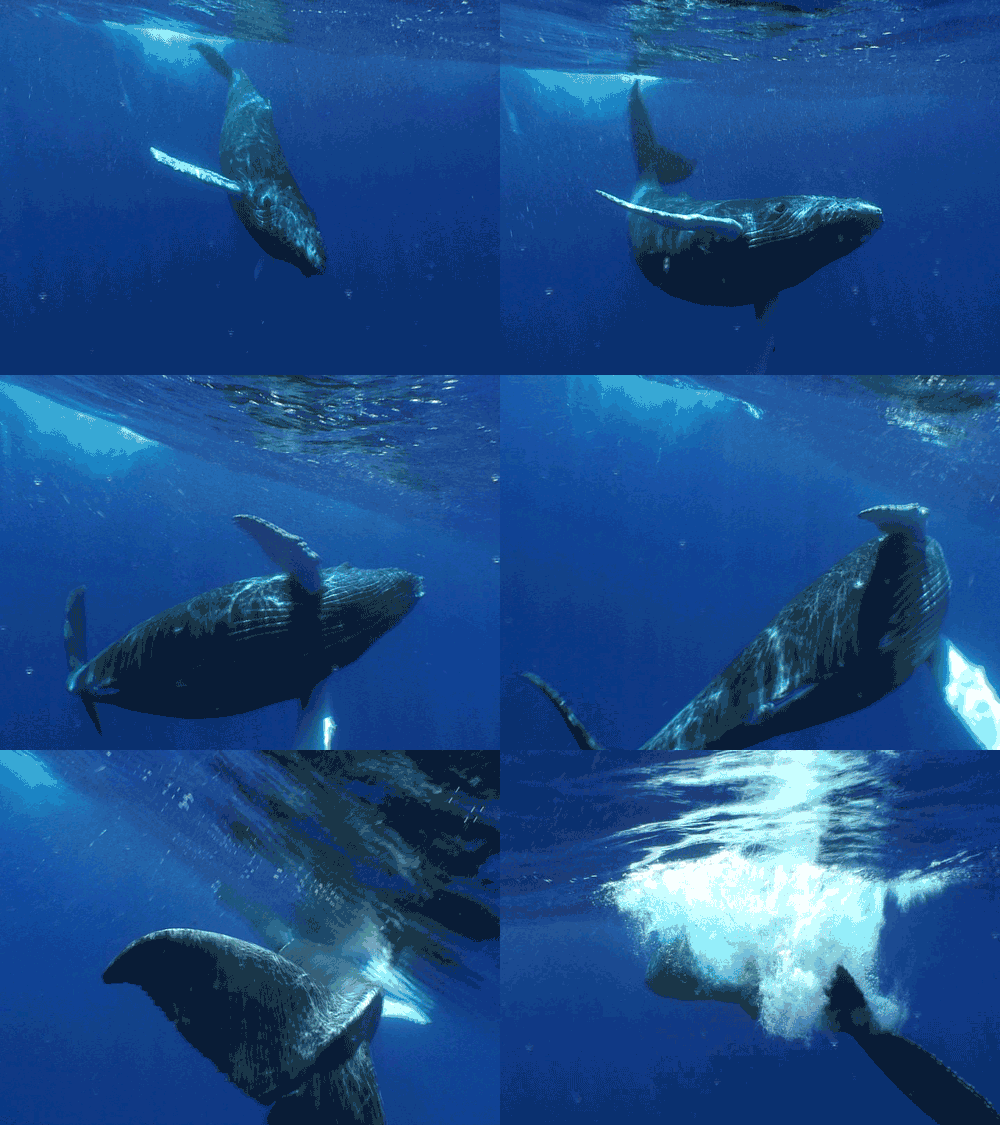
The researchers believe that different parts of a humpback's song may be shaped by different pressures. Themes sung at relatively constant depths during the deepest part of a dive showed different patterns of variation from themes sung elsewhere. One possible explanation is that songs in these deeper portions of a dive may be more strongly influenced by sexual selection.
In other words, variation in these themes might help a male stand out to potential mates. Other portions of the song may be more constrained by the physical demands of diving, including oxygen management and buoyancy.
These are interpretations supported by the patterns the researchers observed, not a complete decoding of whale communication. We still don't know everything humpbacks are communicating through their songs. The study doesn't establish that every theme has a specific meaning or that a whale is deliberately changing a song to accomplish a particular task. But it offers researchers a new way to investigate the relationship between what a whale sings and what it does.
And that opens some interesting possibilities.
Why This Research Matters Beyond the Song.
Here's where the work becomes important for more than those of us who love whales. Scientists already use underwater acoustic monitoring to study whale populations. By recording sounds, they can learn about whale presence and activity in places where direct observation is difficult. If researchers can establish reliable relationships between song structure and diving behavior, those recordings may eventually provide additional clues about where whales are in the water column and what they are doing. That could help scientists develop a better understanding of normal humpback behavior. And knowing what is normal matters when you're trying to determine whether human activity is disturbing an animal. Vessel traffic and underwater noise can affect marine life. A better understanding of how whales behave and sing under different conditions could help researchers investigate those impacts more effectively.
There are still limits to what we can conclude. The study focused on whales in Hawaiian breeding waters, and researchers have yet to establish whether the same patterns hold for humpback populations elsewhere. Different populations have their own song traditions and evolutionary histories. Testing whether these findings apply more broadly will require comparable data from other breeding grounds around the world.
That's another reason I find this research exciting. It gives scientists new questions to pursue rather than pretending to have answered all the old ones.
A Personal Connection to the Science.
The more I read about this study, the more I thought about my grandmother. And I would love to have been able to sit down with her and discuss this research.
- What would she have thought about the idea of using suction-cup tags to record both the songs and the movements of humpback whales?
- What questions would she have asked?
- What would she have wanted researchers to investigate next?
I can't answer those questions for her. But I can imagine how fascinating she would have found the effort to connect animal behavior with underwater acoustics.
Julia Zeh's work grew out of doctoral research at Syracuse University, combining bioacoustic analysis with biologging technology to investigate a subject that had long been studied primarily through sound. Since completing her doctoral studies, Zeh has continued her work in ecological monitoring and conservation, including work with NOAA's Northeast Fisheries Science Center and the Maine Department of Marine Resources.
It's a reminder that scientific discoveries often emerge from years of patient observation, careful data collection, and the willingness to look at a familiar subject in a new way.
Sometimes the breakthrough isn't a brand-new technology or a spectacular discovery visible from space. Sometimes it's finding a new question to ask about something scientists have been studying for decades.
The Ocean Still Has Plenty to Teach Us.
I started this story with a memory of a blue whale passing beneath a boat full of excited people.I ended up learning about tiny recording devices, sixteen-hour singing sessions, the physical demands of diving, and the possibility that the structure of a humpback's song can reveal something about its movements. That's quite a journey.It also reinforces something I've believed for a long time: the natural world is full of things worth investigating, even when we think we already understand them. We have studied whales for generations. We know a great deal about their behavior, their migrations, their songs, and the challenges they face in an increasingly noisy ocean. Yet every new study seems to remind us how much remains to be learned.I still want to see a blue whale again.
Again! I still dream of experiencing the ocean underwater, as close to these magnificent animals as safety and responsible wildlife practices allow. And I still wish I could talk about all of this with my grandmother. For now, I'll keep reading, asking questions, and sharing the discoveries that capture my imagination. And I have a question for you.
Have you ever had an encounter with wildlife that changed the way you looked at the natural world?
Or is there an animal you've always wanted to see in its natural environment?
I'd love to hear your story.I've lit the fire. There's room for another whale lover, another curious mind, and anybody who believes the world still has a few surprises left for us.
Welcome home.