What We Can't See on Distant Worlds!
I've loved astronomy since I was about twelve years old. NASA, space, anything that helps explain what's out there — I've followed it for decades, and I never really outgrew the fascination. Some kids wanted to be cowboys. I wanted to know what was happening out there among the stars. And, all these years later, I still have questions.
A while back, I saved an article about a discovery involving distant planets. I read it, thought it was fascinating, and then did what I've been known to do: I put it aside while I figured out what I wanted to say about it. That article has been waiting patiently in my folder of possible posts. Today, it's getting out. Here's why.
Planets Missing From Our Neighborhood
One of the first things that caught my attention was that some of the most common planets astronomers have identified around other stars don't exist in our own solar system. They're called sub-Neptunes. As the name suggests, they're generally smaller than Neptune, and they appear to be made up of some combination of rock, gas, and water. They're not quite like rocky planets such as Earth, and they're not gas giants like Jupiter, either. Yet our solar system doesn't have a single one.
Think about that for a moment. We're trying to understand a whole class of planets without having a local example to study up close. Astronomers have to combine telescope observations with computer models to figure out what these worlds might actually be like. The universe, apparently, didn't feel obligated to build every solar system from the same blueprint. And that brings us to a fascinating question: What if some of these planets contain far more water than we can see?
What Webb Might Be Missing
The article that started me down this rabbit hole came from scientists at the University of Chicago. Their study, accepted for publication in The Astrophysical Journal, examined how water and hydrogen might behave inside these unusual planets. Their case study was a planet called TOI-270 d, orbiting a star in the constellation Pictor.
NASA's James Webb Space Telescope had detected evidence of hydrogen, methane, and carbon dioxide in the planet's atmosphere. Those observations, combined with the scientists' understanding of the planet, suggested that abundant water might also be present.
But here's where things get interesting. Scientists have often worked with the assumption that the ingredients in these warm planetary atmospheres would be mixed fairly evenly. If that's true, measurements of the atmosphere can help researchers estimate what's happening deeper inside. The research team investigated whether that assumption always holds. It turns out that water and hydrogen don't necessarily stay mixed under every set of conditions. Depending on the composition and temperature, water could separate from the lighter hydrogen and sink deeper into the planet.If that happens, a telescope studying the upper atmosphere could miss a substantial amount of water farther down.
Now, let's be careful here. Nobody discovered a hidden ocean on TOI-270 d. The researchers modeled a possible explanation for how water might behave under certain conditions. Whether this particular planet actually fits that scenario remains uncertain. There's a big difference between saying, "We found it," and saying, "Our calculations suggest it could be there, but we can't confirm it yet."Both are worth talking about. One just makes a much better headline than the other.
What might lie beneath the atmosphere of TOI-270 d?
This scientific illustration depicts a proposed interior structure and atmospheric profile of the distant exoplanet.
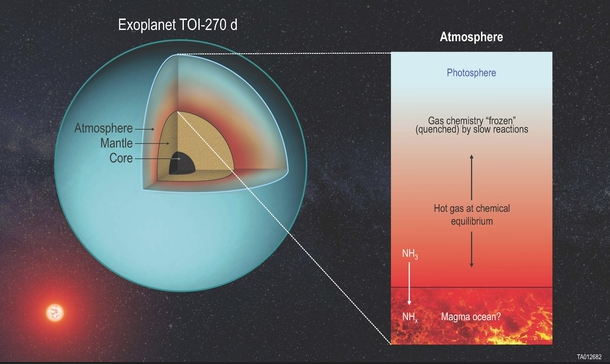
Researchers use observations and models to investigate what these worlds might contain, but the planet's interior has not been directly observed.Illustration: Paul Gilster/Centauri Dreams, “TOI-270 d: The Clearest Look Yet at a Sub-Neptune Atmosphere” (April 22, 2025).
Reading Someone's T-Shirt
Why does any of this matter? Stay with me, because this is the part that made me want to write about the study. The James Webb Space Telescope can help scientists identify molecules in the atmospheres of planets orbiting distant stars. Stop and think about that for a second. We're analyzing the chemical ingredients of worlds we may never visit, using light that has traveled across enormous distances.
That still amazes me.
But knowing what's in an atmosphere isn't the same as knowing everything about the planet underneath it. I think of it this way: Imagine meeting someone and deciding you understand the whole person because you've read their T-shirt. You learned something real. The shirt might tell you their favorite team, their sense of humor, or a cause they care about. But it doesn't tell you their whole life story.
For all you know, the guy wearing a Green Bay Packers shirt (#GOPACKGO) might be a perfectly reasonable human being. Well, most likely. The point is that the information is useful, but incomplete. That's the challenge facing scientists studying these planets. They have real measurements, but they need models and additional evidence to work out what those measurements mean about the interior.Water makes the problem even trickier. Its density falls between that of some other planetary materials, meaning that different combinations of rock and gas can produce similar clues.
More measurements could help scientists distinguish between competing explanations. The telescope isn't failing. It's giving researchers valuable information. The challenge is figuring out how much that information can tell us about a world we can't examine directly.
And that, to me, is a pretty remarkable scientific problem.
The Honest Part
You know I like to keep this place honest, so let's separate what might be possible from what we actually know. Even if TOI-270 d contains abundant water, that doesn't mean it has an Earth-like ocean, a habitable surface, or anything living in it. The conditions deep inside a planet like this could involve enormous pressures and temperatures. We're talking about a very different environment from the one we enjoy here on Earth.
Water is an important ingredient in life as we know it. But water alone doesn't guarantee life, and scientists haven't established that these planets are suitable places for it. So when you hear that water may be beyond Webb's reach, remember that the issue isn't simply how far away the planet is. It's also what lies beneath the atmospheric layers we can investigate. And there's another humbling detail worth considering. We've never drilled more than about 7.5 miles into Earth. That's barely a scratch on the planet's crust, and we're standing right on top of it. We've learned an extraordinary amount about our own world without physically reaching most of its interior. Now we're trying to understand the interiors of planets orbiting other stars.
If that doesn't give you a little perspective, I'm not sure what will.
What We Don't Know Is Part of the Story
Here's what I like most about this research: it doesn't offer a neat, finished answer. The scientists can't yet confirm which explanation describes TOI-270 d's interior. The water might behave as their models suggest, or further evidence might point in another direction. That's not a failure. It's an honest account of where the science stands. I think we sometimes get so accustomed to hearing about breakthroughs that we forget how much of science consists of asking better questions. A telescope makes new observations possible. A model offers an explanation. Further observations and better models help researchers determine whether that explanation holds up. It's a process, not a magic trick.
And no, I don't pretend to understand every bit of the physics involved. I'm not going to put on a lab coat, point at a complicated equation, and hope nobody asks me to explain it. But I've loved astronomy since I was a kid, and I know a good mystery when I see one. Part of me wants every one of those distant planets to be hiding something wonderful. The other part knows better than to get ahead of the scientists.
Both parts can sit by the same fire.
So here's my question for tonight. What fascinates you more: the possibility that distant planets contain things we've never imagined, or the ingenuity it takes for scientists to figure out what's happening so far beyond our reach?
I'd love to hear your take. You don't need a degree in astronomy to join this conversation. Curiosity is a perfectly good place to start.
I've lit the fire. There's room for one more.
Welcome home.