Two Women. Two Choices. One Fight for Freedom.
Sally Hemings and Ona Judge. The courage to take control of their own lives.
(Remembering the people history forgot.)
Starting with the White Mouse, Nancy Wake, and moving through figures such as Bass Reeves, Kim's Warriors wants to shine a light on people and events that somehow managed to slip through the cracks of our history books. History is full of extraordinary people. There are far too many for any of us to learn about every one of them. But that doesn't mean we shouldn't make an effort to remember some of those whose stories deserve to be told.
Throughout human history, we've repeated our mistakes, sometimes with remarkable consistency. But that doesn't mean there is nothing to learn from the people who stood up, survived, and refused to surrender when the odds were overwhelmingly against them. I suspect this may become a recurring feature at Kim's Warriors. I want to introduce you to people whose names might not have appeared in your schoolbooks, but whose lives deserve considerably more attention than they've received.
There is something these individuals have in common. They weren't necessarily generals, politicians, wealthy benefactors, or people with powerful friends. They didn't have organizations behind them, legal teams waiting to defend them, or the luxury of walking away when circumstances became unbearable.
They were fighting for themselves, and often for their children and the people they loved.They had very few options. In some cases, they had virtually none.I can relate to the idea of having to find your own way forward, although my circumstances have been tremendously less challenging than theirs. Perhaps that's why these stories resonate with me.
Today, I want to introduce you to two women who lived during the early years of our country's history. Both were enslaved. Both found themselves at the mercy of extraordinarily powerful men. And both made decisions that would change the course of their lives. Their approaches were very different. One negotiated. The other escaped.
Neither was willing to simply accept the future that had been chosen for her.
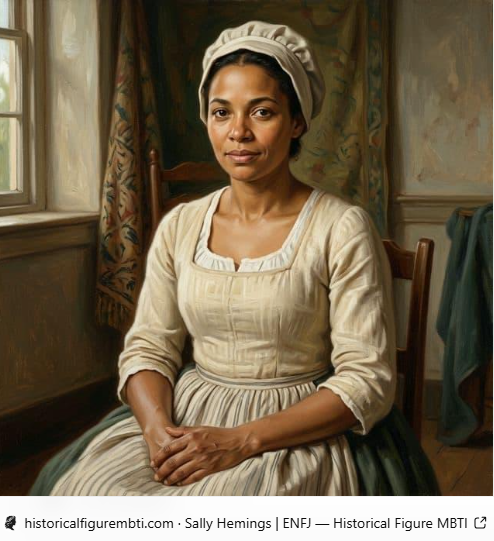
1. Sally Hemings (1773–1835)
The woman who negotiated for her children's freedom
Imagine being a teenager, having virtually no control over your own life, and finding yourself in a foreign country with a man who holds power over nearly every aspect of your existence. Now imagine that man is Thomas Jefferson. Jefferson was one of the principal architects of American independence, the third president of the United States, and a man whose words helped define the American ideals of liberty and equality.
He also enslaved hundreds of people during his lifetime. Among them was Sally Hemings.
Jefferson's relationship with Sally Hemings presents one of the most uncomfortable contradictions in American history. Here was a man who helped articulate the principle that all men are created equal, yet fathered at least six children with a woman whom the law considered his property.
Let's be clear about something. Sally wasn't Jefferson's social equal. She wasn't an employee who could resign, a romantic partner who could freely walk away, or a woman with the protection of the law. She was enslaved.The power imbalance was enormous. Jefferson controlled her circumstances, her freedom, and the future of her family.
An opportunity in Paris
Sally was born into slavery in Virginia in 1773. Her mother was Elizabeth, known as Betty, Hemings. Her father was John Wayles, a wealthy white lawyer and slave trader. There was an extraordinary family connection: Wayles was also the father of Martha Wayles Skelton, who became Thomas Jefferson's wife. Sally and Martha were therefore half-sisters.
Following Wayles's death, Sally and members of her family became part of the estate inherited by the Jefferson family.In 1787, at approximately 14 years old, Sally accompanied Jefferson's young daughter Maria to Paris, where Jefferson was serving as America's minister to France. She remained there for approximately two years. Paris offered something she had never experienced in Virginia: a genuine opportunity to claim her freedom.
Under French law, enslaved people brought into France could petition for freedom. Sally worked in Jefferson's household, performing domestic duties and serving as a maid. When Jefferson prepared to return to Virginia in 1789, Sally faced an extraordinary decision.
According to the account given by her son Madison decades later, she initially refused to return. She understood that going back meant returning to slavery. She was approximately 16 years old, pregnant, and facing the possibility of having to build a life alone in a foreign country.
She negotiated. Madison Hemings later described an agreement in which Jefferson promised his mother extraordinary privileges and freedom for her future children.
Think about that for a moment. A teenage girl negotiated with a man who would eventually become President of the United States. She was negotiating for children she had not yet had.We should not romanticize the circumstances. She wasn't negotiating from a position of equality. She was trying to secure whatever protection and future she could for herself and her family.
She returned to Virginia.
Six children and a promise
Jefferson's records document six children born to Sally Hemings, although two died in infancy. Four survived to adulthood:
- Beverly
- Harriet
- Madison
- Eston
Historical documentation, family testimony, and DNA evidence strongly support Jefferson's paternity. For generations, the relationship was disputed and frequently dismissed by Jefferson's defenders. DNA testing in 1998 established a genetic connection between descendants of Eston Hemings and the Jefferson paternal family line. Combined with the historical evidence, the findings strongly support the conclusion that Jefferson fathered Sally's children.
Did Jefferson honor his promise?
In an important respect, he did. Beverly and Harriet were permitted to leave Monticello in the early 1820s and passed into white society. Madison and Eston were freed in Jefferson's will following his death in 1826.
Sally herself was never formally emancipated. Jefferson's daughter Martha allowed her to live as a free woman in Charlottesville, an informal arrangement commonly described as being "given her time."
Sally remained there with her sons until her death in 1835. She never received the formal freedom her children eventually obtained.
What should we remember?
It's easy to make this story entirely about Thomas Jefferson. His political achievements, his writings, and the contradictions between his public ideals and private conduct will always make him a subject of historical debate. But that's not why we're telling this story.
We're telling it because Sally Hemings deserves to be remembered as a person in her own right. We know remarkably little about her in her own words. Much of what we understand comes from Jefferson's records, historical documentation, and the testimony of her son Madison. But we know this: she found an opportunity, recognized what was at stake, and negotiated for the future of her children.
She couldn't dismantle slavery. She couldn't force Jefferson to recognize her as an equal. She couldn't even secure her own formal freedom.
But all four of her children who survived to adulthood ultimately lived as free people. That is an extraordinary legacy.
And now, let's meet a woman who took a very different approach.
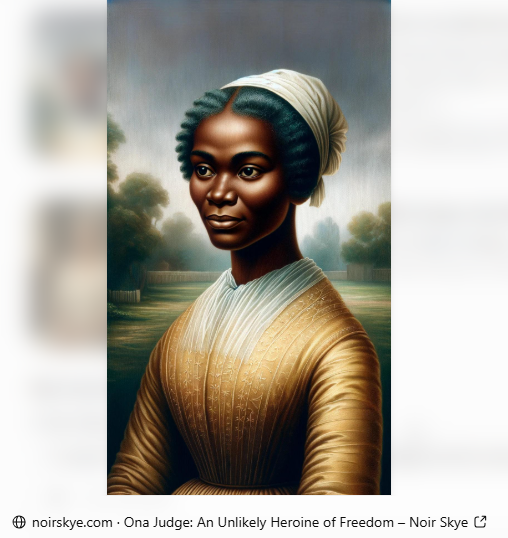
2. Ona Judge (circa 1774–1848)
She didn't negotiate. She ran.
If Sally Hemings found a way to negotiate within an oppressive system, Ona Judge decided she wasn't going to wait for that system to give her anything.
She was going to leave. And she was prepared to risk everything to do it. Ona, frequently called "Oney" by the Washingtons, was born into slavery at Mount Vernon, the Virginia estate of George Washington.
Her mother, Betty, was an enslaved seamstress. Her father, Andrew Judge, was a white English tailor who worked at Mount Vernon. Ona belonged legally to the Custis estate, inherited by Martha Washington from her first husband, Daniel Parke Custis.
At approximately ten years old, Ona became Martha Washington's personal maid.
She was an accomplished seamstress and performed the intimate domestic duties expected of someone serving the household's most important woman. When George Washington became president, Ona accompanied the family to New York and eventually Philadelphia. She was now serving in the household of the first President of the United States. But Philadelphia presented something the Washingtons hadn't anticipated: an opportunity for freedom.
The Philadelphia loophole
Pennsylvania had passed the Gradual Abolition Act of 1780. Under its provisions, enslaved people brought into the state by slaveholders could become legally free after six consecutive months of residence, subject to the law's terms. George Washington knew about the law.
Rather than allow the enslaved members of his household to establish the required residency, he arranged for them to be periodically transported out of Pennsylvania and back to Virginia. The Washington household effectively reset the clock every six months. Washington's own correspondence documents his efforts to arrange these movements discreetly, even asking his secretary to use a pretext that would deceive both the enslaved people and the public.
Consider the circumstances.
The man who had led the American Revolution and become the country's first president was deliberately working around a state law that offered enslaved people a path to freedom. Ona, however, was living in a city with a substantial free Black community and abolitionist networks. She was exposed to people who had secured their freedom and to possibilities that had been largely unavailable to her at Mount Vernon.
She began to understand that another life was possible.
The wedding present
In 1796, Martha Washington's granddaughter, Elizabeth Parke Custis, married Thomas Law.
Ona learned that Martha intended to give her to her granddaughter as a wedding present.
Think about what that meant.
After years of serving Martha Washington, Ona was about to be transferred to another household. Her future would be determined by someone else's decision, and she would have no say in it. She had no guarantee that her new circumstances would be better. In fact, she had reason to fear they would be considerably worse.
In a newspaper interview years later, Ona explained why she chose that moment. She said she was determined never to be her granddaughter's slave. That was the breaking point.
She had reached a decision.
May 21, 1796: The escape
While the Washingtons were eating dinner at the presidential residence in Philadelphia, 22-year-old Ona Judge walked out. She had prepared beforehand, arranging for her belongings to be taken to friends in the city's free Black community. made her way to the waterfront and secured passage aboard a vessel called the Nancy, a sloop commanded by Captain John Bolles.
The destination was Portsmouth, New Hampshire. It was an extraordinary risk. She was leaving behind her family, her familiar surroundings, and whatever limited security she had known.She had no guarantee of where she would sleep, how she would earn a living, or whether she would ever be caught.
But she was leaving slavery. And she wasn't going back.
George Washington wanted her returned
Ona's escape infuriated the Washington household. Newspaper advertisements were placed offering a reward for her return. Washington contacted associates and attempted to locate her. Eventually, she was discovered in New Hampshire.
Washington enlisted the assistance of Joseph Whipple, the Portsmouth customs collector, to persuade her to return. Ona refused. She even offered a remarkable counterproposal.
According to the historical correspondence, she indicated that she would consider returning if the Washingtons promised to free her upon their deaths.
Washington rejected the arrangement.His response is revealing. He argued that granting her request would reward disobedience and create dissatisfaction among the other enslaved members of his household.In other words, her refusal to remain enslaved was being treated as a disciplinary problem. But Ona had made up her mind. The pursuit didn't end there.
In 1799, Washington enlisted his nephew, Burwell Bassett Jr., to locate Ona and bring her back. Bassett found her in New Hampshire and contemplated taking her by force. A sympathetic U.S. senator, John Langdon, learned of the plan and arranged to have Ona warned.
She escaped again, taking refuge in nearby Greenland, New Hampshire. George Washington died later that year. Ona Judge was never recaptured.
A life in freedom, but not without hardship
Ona eventually married Jack Staines, a free Black sailor. They had three children. She learned to read and write and became part of the community in New Hampshire. Her life wasn't easy. She experienced poverty, loss, and the difficulties of supporting a family as a free Black woman in a society that offered very few opportunities.
Her husband died in 1803. Her children also died before her. She had left behind her mother, siblings, and the family she had known at Mount Vernon. She never regained those relationships.
In interviews published in abolitionist newspapers during the 1840s, Ona was asked about her escape and her life afterward. She never expressed regret about leaving. She had made her choice.
She was free. Ona Judge died in 1848, having spent more than fifty years outside the reach of the Washington family.
Two women. Two extraordinary decisions.
There is something about these two stories that I find particularly compelling. Sally Hemings and Ona Judge lived during the same period, within the same institution, and under the control of two of the most influential men in the founding of our country.
Both were enslaved. Both had their lives and futures determined by people who held enormous power over them. Neither had access to the protections we take for granted today. But they responded differently.
- Sally found an opportunity to negotiate. She returned to Monticello with a promise that her children would eventually be free. That promise was ultimately fulfilled, although she herself never received formal emancipation.
- Ona saw what was coming and refused to accept it. She left the presidential household, boarded a ship, and built a life in a place where the Washingtons could no longer control her.
One fought for the freedom of her children through negotiation. The other fought for her own freedom through action.
Neither woman was in a position of strength. Neither had a safety net. Neither could count on the law to protect her.
And That's the Point I Want to Leave With You.
We spend a great deal of time remembering the presidents, generals, politicians, and people who wrote the documents that established our country. We should. But we should also remember the people who lived on the other side of those documents. The people who were denied the very freedoms those documents proclaimed.
Thomas Jefferson and George Washington are permanent fixtures in American history. Sally Hemings and Ona Judge deserve to be remembered alongside them.
Not as footnotes. Not simply as women who happened to serve two famous families. But as two human beings who faced almost impossible circumstances, found whatever strength they could, and refused to surrender entirely to the futures others had chosen for them.
They were warriors.
And their stories deserve to be told.
That's what Kim's Warriors is about.